Blog Mileage

Update here, dump there, good posts, bad posts, anything goes. That’s what I’ve been doing regularly lately. There would be days I get stuck correcting or revising archives before I repost and there would be days I just copy and paste the article on its original timeline.

You see I’ve been busy. Running, working out, and writing have been fighting to get their own share of my time. For now I continue to focus on my goal to repost and will just worry about them later, hopefully ahead of grammar Nazis or just before Grammarly starts to force me to get its premium service. I just can’t let years worth of posts stay on my backup Word document which I saved prior to me messing up my site few years back when I wiped out several posts just because I forgot to pay attention to what I was clicking. Lesson learned: back up, back up, back up.

Today I reposted a couple more and I received a prompt from WordPress that I just hit 500 posts. Wow. And to think I’m just about to finish year 2008.

Another WordPress achievement.

***

There are things that just can’t be part of my conscious effort to embrace minimalism. Writing is one as I now have drafts and doodling all over my phone, laptop, paper notebook, and some hang on in my head. This is one of those few cases wherein clutter is probably good.

Then there’s material stuffs. This week I gave wifey the approval to buy the TV she’s been wanting to have and been saving for. The least I could do on Valentine’s week is to give a nod. There’s now a giant Ultra HD Devant TV in the middle of our small house which made me realize 50-inch is the biggest we can get unless we hang the TV across the kitchen and view it from the living room. So far the Call of Duty and Fallout 4 games of our 9-year old son have been more gory.

***

Claimed our free Starbucks cake. Free always tastes better.

Wifey also got me a pair of new jeans while in SM San Pablo last Monday. This one is for the books as the last time I purchased a pair was almost five years ago. My existing pants are either tattered not by design but due to wear and tear and all of them, FYI, are a couple of inches loose already. I need a new belt next.

***

Mood: 2/10 Honks! (Cold Valentine’s Day weather.)

Time to Learn SEO Again

SEO starts to sound exciting once more. It could have been a year or more since I gave up on SEO because I just find it hard to understand. I once believe that knowing keywords and inserting them strategically in an article is SEO already. It was wrong, completely wrong. Keyword density wasn’t enough.

The problem with SEO is that there are so many people who claim to be experts. Tools and tips that these people recommend are either complicated or doesn’t work–at least for me. Some are just downright confusing that eventually made me stop caring much about driving traffic to my site. As long as I can write and post an article then I am already fine with it. Screw traffic.

But we need traffic and SEO drives blog traffic. Just this week I read The Next Web’s article titled SEO Simplified For Short Attention Spans. It is probably the most interesting article I have read about SEO to date. Maybe I have short attention span or maybe the explanations the article presents do make sense for someone who has given up on SEO. Or maybe it has something to do with my recent return to article writing, thanks to oDesk, which made me get interested about it again.

This week I look forward to spending time in front of our desktop and start all over again. The plan is to start looking into META and ALT tags which are the things I have ignored but could actually impact my site’s visibility. Wish me luck.

***

First accomplishment was changing from ugly permalinks to pretty permalinks.  It pose a bit of challenge as the Dashboard is deceiving. It appears that it is a matter of just clicking on the radio button and save changes but it is not. The web.config.xml needs to be updated as well and WordPress.org forum has answers that could confuse further so below are two short steps to cut the chase.

Pretty permalink, ugly permalink, How to make pretty permalink work
How to change from ugly to pretty permalinks.

The original web.config.xml file contains the following below. Use an FTP client to save the file to your desktop.

<?xml version=”1.0″ encoding=”UTF-8″?>
<configuration>
<system.webServer>
<rewrite>
<rules/>
</rewrite>
</system.webServer>
</configuration>

To make the permalinks work, what needs to be done is just to change the content to:

<?xml version=”1.0″ encoding=”UTF-8″?>
<configuration>
<system.webServer>
<rewrite>
<rules>
<rule name=”WordPress Rule” stopProcessing=”true”>
<match url=”.*” />
<conditions>
<add input=”{REQUEST_FILENAME}” matchType=”IsFile” negate=”true” />
<add input=”{REQUEST_FILENAME}” matchType=”IsDirectory” negate=”true” />
</conditions>
<action type=”Rewrite” url=”index.php?page_id={R:0}” />
</rule>
</rules>
</rewrite>
</system.webServer>
</configuration>

Overwrite original file by uploading it back to your WordPress directory. Bingo, pretty permalinks!

Source: http://codex.wordpress.org/Using_Permalinks

***

Mood: 2/10 Honks! (Pacman-Algieri fight. And we need to be in Batangas for free cable.)

Write About Writer’s Block

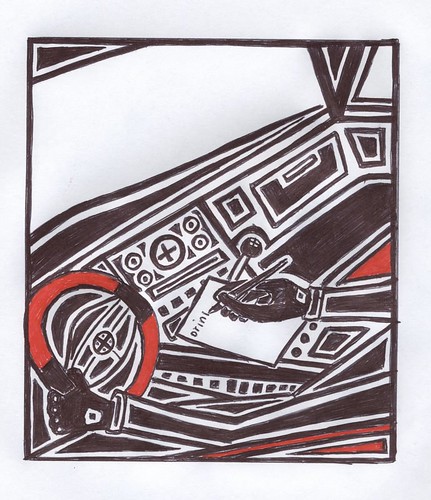
Writing and Driving
Illustration by MIke Kline as posted on Flickr Creative Commons page.


A day left before August ends and it’s me – 0, writer’s block – 1. No reason, just excuses. But this tweet from @AdviceToWriters uplifts me:

Writing about a writer’s block is better than not writing at all — CHARLES BUKOWSKI

On a traffic-free day I arrive early at work and when it happens I either read or write in the car. These past few days I drafted some but never had the time to polish my ideas, one of which is again about hitting the dreaded writer’s block. But I didn’t post it for fear that it will soon become the biggest among my tag cloud. So thank you @AdviceToWriters I learned another tip from you. Yes, anything to write about is probably worth writing.

***

Mood: 2/10 Honks! (Had a good run, had good breakfast.)

How to Quickly Align Text From PDF to Word

The afternoon schedule of my kid has given me the time to continue reposting old blog posts that I have saved using Feedfabrik. Without this application I would have lost everything I wrote since 2006 when I made a boo-boo during a WordPress upgrade about two years ago. (It’s a blessing in disguise though as I have discovered a LOT of embarassing grammar lapses.)

Copying and pasting, however, from PDF to Microsoft Word creates an alignment problem which I have been patiently dealing with for weeks already. Realizing that I have barely achieved a significant percentage of repost–my Feedfabrik proof PDF file has more than 1200 articles–I finally turned to the internet for help. Someone out there must have had the same issue. I was right.

Thanks to Superuser.com, I found the answer to my problem. And it’s a very simple one.  Shown below is a screenshot from my MS Word that shows the same set of text from my PDF file.

Don’t mind the excerpts, I’m about to edit it.

Upper half of the picture is how it appears when text is pasted directly from the Feedfabrik proof.pdf file.  Looks easy to align, right? But if there’s a thousand pages to deal with, trust me, it will drain anyone out.

The lower half of the picture is the way to go and it’s done using a neat trick from Superuser.com which I simplified below.

1) Copy text from PDF.

2) Paste text on Google search box (I assume this will work with any other internet browsers).  Do not worry about the length of the text, it doesn’t matter as the next step will get everything back.

3) Use CTRL+A (or CTRL+X) to copy every text you pasted on the search box.

4) Paste text on MS Word.

Take note though that if there are multiple paragraphs being copy and pasted, each paragraph has to be manually separated from the other. But this is something I can handle unless there is another trick to solve this.

Now where was I? Ah, December 22, 2006. Hmmm, bad grammars.

***

Mood: 3/10 Honks! (Still with runny nose after four days. I hope I’d be better tomorrow.)

Easter Bani

Trying to collect himself and checking his location, Bani feels the unmistakable warmth of the bed. It’s still dark but he knows very well that he just woke up neither from a leather-clad, double deck bed nor from a Lazy Boy, both of which where he has perfected 5-minute naps in almost a year; more so in the recent weeks when his sleeping pattern has been abnormal. Well, more than just his sleeping pattern, actually.

Few minutes more of staring blankly at the Discovery program on the wall- mounted TV, he fumbles for his phone, placed alongside the TV’s and air conditioner’s remote control, and an empty liquor glass. “It’s 5 AM,” Bani silently reads from the blinding glare of his Nokia.

Bani soon realized that the cheap gin from his Black Saturday night cap has dried up where it spilled just barely a foot away from where his little boy, Raffy, lies. Just like last week, he has decided to return home from a planned sleepover with the family Bani has jokingly called ‘The Wilsons,’ Raffy being Dennis the Menace.

“Once again, he wants back,” the puzzled ‘Mrs. Wilson’ who lives just a couple of houses away, tells of Raffy who used to enjoy spending the night with them.

An hour more and Raffy remains static, his left thumb in his mouth, eyes partially shut. “His eyes look a lot like you,” he remembers the usual line his wife would tell him, referring to the partially opened eyes. Friends have told him it also means that he distrust people. Bani would agree.


Why I Now Care More About Plagiarism

What a surprising way to welcome myself back to the online world after my self-imposed (trying to still be a good Catholic somehow) 3-day internet hiatus. As I slowly back-read tweets I began to see the a pattern of striking news from several tweeps I follow—tycoon Manuel V. Pangilinan has offered to retire as ADMU’s chairman of the board of trustees after someone exposed his recent speech to the school’s graduates as having been copied from celebrities like Oprah Winfrey, Conan O’Brien and J. K. Rowling. In short MVP was guilty of plagiarism. So what really is plagiarism?

Basically, plagiarism is a word commonly defined as copying someone else’s literary work and trying to pass it off as one’s own. Literary works among other things like movies, technical drawings and music become copyrighted as soon as its original author makes it; which means that the author assumes immediate ownership and thus when his writings (or any other work) are plagiarized by another person, makes the act alone technically, a form of stealing. The topic of plagiarism has been actually a topic of discussion and argument among authors and scholars for a very long time, and as a matter of fact, according to Answers.com plagiarism dates back from the 17th century. The site’s definition states that the word plagiarism has its roots from the Greek word plagion which means to ‘kidnap.’ Furthermore, Plagiarism.org has a list of things that constitutes plagiarism. Here are some of them: 

Changing words but copying the sentence structure of a source without giving credit.” This may occur when someone paraphrases, or reword, a thought but still ending up with almost the same as what the original document contains. This is either a product of poor reconstruction OR a purposeful intent to deceive its readers.

Copying so many words or ideas from a source that it makes up the majority of your work, whether you give credit or not.” This instance would normally arise if one comes to a point when he wrongly decides to get as much facts as he can in order to support an argument, an analysis or a conclusion.

Failing to put a quotation in quotation marks.” Many of today’s technology applications probably make everyone guilty of this no matter how well the intent. Case in point, one can easily find in social networking sites, such as Facebook, sharing of inspiring stories or quotes which without the mere quotation marks (and worse, the quote’s author) may make someone who is not aware of the quote think that it actually is his/her friend’s own thought. There’s also Twitter (and SMS) where limits in the allowable characters makes it easy for one to plagiarize.

So is plagiarism bad? Yes. But like any other wrongdoing, it would be ethical to listen and know why someone did it in the first place. Again, Plagiarism.org sums up two general reasons why the act.

Intentional

According to plagiarism.org, those considered to be intentional are reasons like ”everyone’s doing it”—so why can’t I? ”But there words are better”—and why the need to waste time thinking about when in fact there’s already one that has been done by one who’s an expert. And there’s of course, the need to ”make the grade” which may be arise from cramming after realizing that schedules cannot be met. 

Unintentional

There are of course who despite their best effort to avoid plagiarism still fall to the trap of making the mistake of plagiarizing someone else’s work.

And also listed on Plagiarism.org are the following reasons students plagiarize:

There is “citation confusion.” According to this site, this is perhaps the most common reason students are caught plagiarizing. The question now is, “How should one make a citation?” Wikipedia.org has the answer. It says, ”While you should try to write citations correctly, what matters is that you add your source—provide enough information to identify the source, and others will improve the formatting if needed.” This simply implies that there is really no rule on how to cite a source as long as what is written to acknowledge it is correct and updated. Such rule may prove useful if a document or presentation will be for an informal setting (or if one is just preparing a draft) or if one is citing an online source as copying exactly the URL (or link) may be enough. Of course such isn’t always the case. Wikipedia.org explains further, ”Each article should use the same citation method throughout. If an article already has citations, adopt the method in use or seek consensus before changing it.” These statements refer to formal research, like in the Academe, where appropriate formats of citation are to be observed. Examples of recognized formats are the APA style, MLA style and The Chicago Manual of Style. For students and some individuals picking the choice of which citation format should be followed is just as confusing as the research itself. But at the end of the day, what counts the most is whether he recognized and acknowledged where he got his reference and giving credit to whom credit is due is very important to avoid or repeat such mistake.

Belief that “facts shouldn’t be quoted.” The availability of the internet and the thinking that what is being presented is common knowledge is one of the reasons  many think that it is not necessary to cite what they have extracted. In order to avoid plagiarizing, the website suggests a short yet foolproof tip, ”when in doubt, cite sources.”

The existence of “cultural relativism.” It is quite noteworthy that not every culture actually recognizes the need to acknowledge literary works. It is not therefore surprising if expat students who come from different cultural backgrounds commit plagiarism as their awareness to giving credit to literary works may be different compared with the other local students.

Interestingly another site, Irving Hexham’s Homepage discusses specifically about Academic Plagiarism and defines it as ”the deliberate attempt to deceive the reader through the appropriation and representation as one’s own the work and words of others. Academic plagiarism occurs when a writer repeatedly uses more than four words from a printed source without the use of quotation marks and a precise reference to the original source in a work presented as the author’s own research and scholarship. Continuous paraphrasing without serious interaction with another person’s views, by way or argument or the addition of new material and insights is a form of plagiarism in academic work.

“Deliberate attempt.” These two words from Irving Hexham’s definition is probably the best summary on how to identify whether one is really guilty of plagiarism or not. This definition complements the “unintentional” classification of plagiarism according to plagiarism.org.

After knowing why someone might commit plagiarism despite the best of intentions, the question that lingers is: How can we avoid plagiarism?

Personally, here are my 2 cents:

  1. Follow the ”when in doubt, cite the sources” rule.
  2. Check and re-check research paper if it follows proper citation.
  3. Consult an expert or someone more knowledgeable, if needed.
  4. Be more aware about how others expect their works to be cited.
  5. If possible, as permission directly from the original owner of the material.
  6. Understand Fair Use.
  7. Make use of CC or CreativeCommons.org.

Now, after this lengthy blog, you readers might wonder why I waste precious Easter Sunday time explaining what plagiarism is all about. That’s because just months ago I was into this same embarrassing situation of being accused as plagiarizing a school paper. It was one unbelievable experience because for years after I presented my college thesis–and more especially when I started blogging–I always make sure that I never copy anyone’s work without proper citation. Unfortunately, due to technicalities of this complex subject matter, my stock knowledge of it eventually caught up on me. Since then, I learned from the hard lesson and became more sensitive of how to properly attribute back someone else’s work than before.

***

Mood: 2/10 Honks (F1 Sepang about to start)

How To Generate Ideas

I recently experienced hard times in filling my urge to write and to satisfy my blog readers and subscribers—assuming that they do exist—need to read fresh post. It has become more difficult lately as I don’t only have time to kill but it seems that from the moment I wake up, go to work and come back home, time itself appears to be staring right at me almost saying, “I’m here Cris, what’s next?”

Once again the reminder: Be careful what you wish for, came in late to be retracted. I’ve wished for blogging time, now it’s all I’ve got. The sad thing about it is that my idea bank may be now reaching saturation point. I think I’ve already reached my writing plateau.

Fortunately, the absence of work at work—the irony—had me exploit some available resources that kept me busy while still maintaining our internet usage policy (wink wink). I previously mentioned in one of my blog posts about SkillSoft Books24X7  and right now I just can’t get enough of it. SkillSoft is one of those brilliant things made available for employee skills development.

Now that I’m done with my explanation and defense, let me go on with some of the things I learned about the writing process.

What I find funny when I saw this material is how I got to it. While trying to keep myself busy one day, I typed MBA on the search field of SkillSoft. A few seconds later I was staring at several ebooks with the word MBA high- lighted. Suddenly feeling overwhelmed by the selection, I scrolled further down and it was then that I saw the most interesting thing I’ve seen so far on that lazy day—Methods of Generating Ideas. Despite wondering why this article can only be found under the MBA topic, I was all eyes on my laptop in no time.

The materials showed the following categories and its suggested methods:

Reading and writing. Obviously, reading and writing are the methods. These after all are why most of us learned about things.  This idea-generating category encourages one to take notes by free writing and making an outline of the desired topic. One tip I find very helpful is that the outline need not even be perfect at the start which I always try to do and most likely the reason why I end up with anything but perfect. The material even suggests forgetting about grammar, composition and correct flow of ideas while still of course at the drafting stage. Correction, it adds, comes during editing and proofreading which contrary to my belief are actually two different things. The former is the term applied to the first phase of refining. The latter on the other hand is applied on the final phase or the read-through.

Graphic.  Not all people work well with words.  Others prefer doodling and I was surprised when I read about it because I avoid doodling as I find it a waste of time. This category employs drawing and sketching of one’s ideas that  could be converted to text later on. I tried applying it and it works as lately my ideas don’t have an immediate word equivalent to it especially if my vocabulary lags for whatever reason.

Spoken.  Besides reading and writing, this is what usually works for me. I like talking especially to those who can converse very well and have so many perspectives of different things. It is during such discussion when my light bulb moments happen. I realize that being one of the most talkative pupil in grade school works for me. I now forgive my teachers and classmates for that frequent demeaning tick mark next to my name for talking in class.

Group. Two heads are better than one, there’s no question about it. In fact, group discussions always generate more ideas…well, especially compared to talking to your own self. It is in this context why brainstorming usually works. Such sessions make everyone feel that their presence in the meeting is important and that their ideas are needed and will be welcomed. This in effect creates a continuous flow of ideas wherein some of it may even be totally out of this world. But then again, remember the familiar phrase “Think out of the box”?

Thinking. Now this last category may sound ridiculous as obviously the writing process does need to be start with a thought – at the very least. Duh! But what made me smile was when I reached the line “think about the subject during unstructured time (such as taking a shower, standing in line and taking a walk).” It didn’t clearly encourage thinking while driving though. Nevertheless, despite being amusing to be considered as a method, I still got some tips out of it.

I now have new methods to come up with more ideas. It is therefore worth remembering and applying the other methods other than mere thinking and just taking notes out of my wild mind. I also now recognize that oftentimes the need to read (stress: read, read, read) or interact with one or more people may be what it takes to have fresh ideas whether I like it or not. At the end of the day what matters most is when all of these are consolidated, selected, refined and written in finality hoping that it will fit the main purpose why the idea was formed in the first place.

***

Mood: 3/10 Honks!

Who Visits Your Blog?

“The only way to improve the quality of your life is to improve yourself. If you want to grow your organization, you must grow as a leader. If you want to have better children, you must become a better person.” – John Maxwell

In the last months of 2008 and until now my blog site’s hits picked up. The rate of visitors has increased a lot compared to early part of last year and that of course puts a smile on my face. I attributed the improvement to my recent availability and frequent online activity. I’ve visited old contacts’ blogs, became active in several networks like multiply.com and Friendster, wrote more frequently than before and my wife has been promoting it as well to her colleagues and even her manager which left me wondering if I’d be thankful or not for exposing me up to that level. Anyway, she left a comment and it was one of the most flattering comments I ever had.

That visit and comment though just didn’t add one more blog hits. From then on, I got challenged since I now know who’s been reading, who visited and what probably the expectations of my visitors and readers are. The pressure to write sensible blogs with acceptable composition started. I also began to check what my latest posts were and if I violated some of the company’s confidential policies. The good thing is I didn’t but the bad thing on the other hand is that due to the urge to write more, I seem to have written with so much wordiness yet with less appealing topics, that even I hated it. Surprisingly, the hits kept on rising.

Now I’m becoming worried than ever. I asked myself if I know who’s been coming back, why they come back, what their interests are and how they learned about my site in the first place. With that in mind and similar other observations from the blogging world lit my thinking bulb. It’s time I answer the question, “Who are your blog visitors?”

  1. Lurkers. They are often times blessings in disguise because they increase network traffic and they make up the biggest percentage of a website hits. I suspect The problem with having them though is that they don’t leave any (good or bad) comments which keeps you guessing what they are so interested about that they keep on coming back. Among these lurkers are:
  • Spammers
  • Advertisers
  • Enemies who would love to see you fail.
  • English grammar teachers who are searching for the “I-kill-me-moment” for their next day classes. “Class, please visit crisn.wordpress.com and find as much grammatical error as possible on his post…”
  • Copycats who secretly grab your ideas and plagiarize it on their own blog site (thanks at least for pingback that they get caught somehow).
  • Journalists who are desperately trying to meet the deadline and hoping that a keyword or tag from your post would light up their own light bulb.
  • Your current boss looking for violations in confidentiality.
  • Your next employer.
  • Your colleagues who wonder if you’re the same person they know especially if you’ve kept your writing skill (or the lack of it) secret.
  • Your ex-lover.
  • Bloggers you visited and commented.
  • Social engineers and Phishers.
  1. Same feathers. From the famous “birds of the same feathers flock together” cliché. These are visitors and/or readers who may be also members of the internet forum or egroup you’re currently in. More often than not they don’t necessarily mean that they love your site, your subject matter or even your writing style. More likely, they are just there hoping to exchange links and probably get some ideas in the process. So beware and don’t immediately edit that blogroll of yours unless you’re totally convinced that they deserve that sweet spot in your blog site.
  1. Niche audience. These are the people that you want in your blog They are those who have the same interest as yours and can fully relate to your blah, blah, blahs. They understand your jargons and other fancy terms. Unlike lurkers though, they usually keep in touch with you either through comments or emails. With them, the likelihood of an exchange of useful ideas is very high. These are among the people that you should maintain and have a close relationship with. Either add them to your favorites or add them to your blogroll.
  2. The 3 Fs. They are your Family, Friends and Fans all at the same time–by force or by choice. Although they aren’t as frequent as the lurkers, their visits are usually well-meaning and their praises are true. Just a warning though especially if you’re the type who can’t take criticisms. This group of people (or person) may give blunt comments that will hit you like your mother’s whipping spank–it will hurt, but whether you like it or not, it is for your own good. So appreciate and cherish their comments but listen and act accordingly to their criticisms.

As my employment time is counting down my blog hits however is going up. While laid off, blogging I guess will be my main occupation, paid or not, as I try to figure out what my next moves would be. It is just wise then to know my visitors because through it I get to feel what to improve, how to improve it and hopefully perfect it in the end – no matter when and no matter what it would take. After all, I love writing and I’d be all smiles when the day comes that I do what I really love to do.

***

Mood: 3/10 Honks!

You’re a Blog Addict If…

(A tribute to the return of wp-pinoys.com)

…You have one or more blog accounts.

…Your mind is always wondering what your next blog subject will be.

…You find yourself desperately composing a post even while driving.

…You would rather keep mum during discussions not until you have blogged about the subject matter for fear that other bloggers in your group or anyone would hear about it.

…Every discussion is a good discussion.

…You’ve become masochistic by enjoying confrontations just so you can check if you can make a good blog post out of it.

…You accepted an offer for an extreme adventure not because you love it but because you want to write about it despite the possibility of nausea.

…Microsoft Word and the Internet Explorer browser have been your most utilized application over Powerpoint and Excel.

…”Is the internet connection ok?” becomes your official greeting when you reach home from work.

…Your wife worries about your health whenever you fail to post.

…Your primary concern before a vacation is if your destination offers Wi- Fi.

…You suddenly wake up in the wee hours of the morning just so you can check if what you’ve posted that night had grammatical errors in it.

…You had dreams about you and your conscience arguing about your grammar usage.

…You had nightmares about WordPress.com being wiped out.

…You also had nightmares about your blog drafts being wiped out.

…You are prone to malapropism.

…You’re having symptoms of carpal tunnel syndrome.

You’re justifying to yourself (or wife) that an HP mini is a necessity even during this recession period.

…You’ve set your mind that your fast growing beer belly will become a good netbook platform in case you have to type while standing in a packed train.

…You have your digital camera along with you all the time ready for any “bloggable” event.

…You have considered getting a Paypal account so you can monetize your blog.

…You consider that having your own domain is a good investment.

…You wonder after the homily if the priest has a blog site.

…You’re fully aware that Technorati isn’t related to the Illuminati.

…You’ve approached your boss to let you have a blog time rather than a lunch time.

…Brushing your teeth becomes second to checking your blog hits – and that your mood is dictated by it.

…Other than the internet cafes you’ve also frequented Power Books stores and spent time taking notes of blog materials.

…You can relate very well to this blog. Happy blogging to all!

***

Mood: 3/10 Honks