‘Masa’ iPhone in the Works?

Apple is not stopping and it seems to target the lower-end market this time. If the article from rappler.com is true, then people who currently can’t do anything but envy those who can afford to acquire (whatever it takes) an iPhone will soon be able to get one for themselves.

According to the report, this less pricey Apple smartphone will use cheaper materials for its housing but the rest of its features, hopefully most capabilities, will be retained. Rappler.com adds, however, the folks from Apple have neither denied nor confirmed that this is happening soon but I know that less privileged consumers can wait. At least, I can speak for myself and until then I might stay stuck to this my|Phone which I bought just yesterday to replace my Nokia 5800 phone. Ti abi. Life of a masa.

***

I’m back to basics. The my|Phone B88+ Duo has made me deal with one that doesn’t have a touchscreen and with only an alphanumeric keypad. It is a far cry even from my 5800 — which has quit working — but anyway it gets me connected…through SMS.

Update: Apple has spoken and it’s bad news: the rumors aren’t true which means pricey iPhones stay. Conos — 1, Masa — 0.

***

Mood: 3/10 Honks! (Kiddo demanding to go biking.)

Sad Day for Connecticut

I just woke up from my scheduled nap at work when the news at our pantry room made me feel nauseous — it’s déjà vu. The BBC breaking news was too familiar: another school shooting. And once again, in the US. Suddenly, Connecticut was like a mile away from the Philippines — the news rippled across. The sight of policemen and other authorities scrambling around the crime scene – a school campus –looks all too chilling.

The last time a school shooting happened, I was thinking that it’s just a matter of time when another one will take place again. And it did. But whatever the reasons are – bullying, bad parenting, bad community, TV influence, etc. – I cannot fully grasp. It is always hard to understand what would drive one from doing something evil especially to innocent children. It’s just sad day – 18 dead children, 18 grieving families. And to think that it will be Christmas soon.

***

Mood: 5/10 Honks! (Why?)

(Book Review) Traffic: Why We Drive the Way We Do

Image taken from Google Books

We have all heard it and will likely continue to hear about it: “We Filipinos are bad drivers…no, we are the worst.” “If you have driven in the Philippines, you can drive anywhere in the world.” These and similar other statements about driving in the Philippines have made us stereotype ourselves and in effect made most of us think that the rest of the world drive in an orderly fashion than we do. But wait, this could not be entirely true at all.

If the author Tom Vanderbilt is to be believed, there a lot others out there who are worse than us and our perennial bad traffic flow – and yes, believe it or not, perceived by many as where traffic laws are fully enforced, the US is included. According to his book Traffic, Why We Drive the Way We Do, bad drivers can be found allover the globe and continue to contribute to road congestion, road rage, and accidents, not to mention stress, just to name a few ill effects of the growing volume of cars and other vehicles that are present at one time in one place.

I got my copy of Tom’s book only after two years since the day I learned about its release and it was only because it was on sale in National Bookstore by half its original price. But sooner I realized that the P300 plus I paid for it is a real steal because the 400-page paperback has a lot more to offer than expected. As I progress from one page to another, it stomps out that know-it-all and I-drive-a-lot-better-than-you premise I have had and which I am sure that other drivers possess as well.

Aside from rich facts about relationship (or lack thereof) of man, machine, and the road, almost each chapter of the book contains information never been made known to common drivers. For example, are you aware that car designers, other than complex mathematical algorithms, also have to deal with factors such human psychology and pop culture to cope up with the growing demand for mobility, thus the need for cars, and its effect to traffic?

“Traffic has become a way of life. The expanding cup holder, which became fully realized standard equipment only in the 1980s, is now the vital enabler of dashboard dining…Fast-food restaurants now clock as much as 70 percent of their sales at drive-through windows…” (page 16)

How would you feel if someone presents to you the idea that road signs invite people to violate it more and that by removing these will improve drivers’ behavior?

“Do traffic signs work, and are they really needed at all? This question has been raised by Hans Monderman…How foolish are we in always telling people how to behave. When you treat people like idiots, they’ll behave like that.” (page 190)

And did you know that our balikbayan relatives could be actually lying every time they smirk in the backseat and follow it up with that famous cliché “walang ganito sa states….”? Why? Because Tom Vanderbilt also exposes the US as having its own share of jaywalkers (Why New Yorkers Jaywalk (and Why they Don’t in Copenhagen: Traffic as Culture); traffic light-beating drivers; and motorcycle riders who shun helmet laws.

Released in 2008, Traffic, Why We Drive the Way We Do, contains vast insights, supported by references and citations, about traffic and therefore makes it a must read book for all of us who continue to wonder what causes bad traffic and if there are indeed solutions to it or if there is none, at least change our own perspective of how we and others drive so that we co-exist better than we do today.

***

Mood: 3/10 Honks! (We’ll be in Nuvali later. Driving with or without the low beam.)

The World Has Ended

Are you one of those people who got panicky when the year 2012 started because you know that this is the year when the dreaded doomsday is set to happen? Well, I hate to break this to you but the world has ended already – at least it is what should have happened had some genius did not correct the calendar about 400 years ago and with the assumption that the popular ancient Mayan December 21, 2012 doomsday prediction is correct.

Let’s all rejoice now, however, and accept that 2013 and all the annual routines are coming, like it or not, because like damage control done by some analysts the moment they see that what they once have strongly forecasted are starting to go the opposite directions, I am now starting to see more articles about why the Mayan doomsday might not actually take place this 2012. One good reference I have is from one of my old textbooks which I brought with me to kill time inside a bank whose tag line is ‘We Find Ways’ but so far haven’t found the way to fix its ever long queue (but it is another long and sad story). Pages 58-59 of the book Heroic Leadership by Chris Lowney, has this very interesting information — which I read while standing in line for about an hour:

…By the sixteenth century, Easter Sunday was slowly but inexorably migrating toward Christmas.

Pope Gregory XIII asked Clavius to head a commission investigating the increasingly embarrassing problem. What was going wrong with the calendar? As it turned out, the actual solar year was shorter – 674 seconds shorter…What’s 674 seconds? Not much in a year, but problematic once compounded over centuries…

…In order to undo more than a millennium of compounded damage…Clavius’s commission had Pope Gregory XIII proclaim that in the year of 1582 the day after October 4 would be October 15. Even loyal Catholics had cause to grumble: their lives have been shorted by nearly two weeks.

I have actually underlined these while reading the book back in 2009 just because it tells about the origin why we now have the leap year and that’s it. Besides, during that time when I was still studying TSLEADER subject (under Prof. Lino Rivera who is currently DepEd Undersecretary) I haven’t even heard about any doomsday movie nor news about the end of the world other than what is written in the Revelation. But blame the movie 2012 and the hype surrounding it, December 21, 2012 became the dreaded D-day. Thankfully, as the abovementioned excerpt presents — if (and only if) the ancient Mayans indeed state the date December 21, 2012 in their prediction but failed to factor in the flaw that Clavius eventually corrected — the most feared December 21 has already past.

Yes, I know the feeling. No more modern Noah’s Ark, no more earthquakes of catastrophic proportion that will cause us to jump across gaping cracks on the ground, and the show Doomsday Preppers suddenly turns funny if not totally ridiculous. But who knows?

***

Mood: 2/10 Honks! (Friday afternoon. Watching TV with Marcus. Wifey still on her long siesta.)

Spider-Man or Spiderman?


“Seeing a spider isn’t a problem. It becomes a problem when it disappears.”

— via Twitter.

While Peter Parker had to face problems such as when to be in the right place at the right time to fight crime and whether he should give up his hero status to have a normal life with the girl he has been longing to be with, I on the other hand has begun thinking when the character who I’ve used to know as just Spiderman became to be Spider-Man. Thanks to the grammar OC in me, I made an extra effort to actually send an email to the folks of www.grammarphobia.com, an email which I never expected would be taken seriously but I was wrong; A couple of days after, I received an interesting answer.

Here’s what I wrote to mailbox@grammarphobia.com1:

Good day! This latest Amazing Spider-Man movie made me realize that I have been spelling Spider-Man wrong but I am wondering if there’s any difference between Spiderman and Spider-Man (while I’m typing this letter, the red wriggly line of spell check tells me that the non-hyphenated word is incorrect).”

And here’s the answer: Hi, Cris,

Spider-Man’s name has a hyphen because Stan Lee, who created the comic character with Steve Ditko, apparently wanted to distinguish him from Su- perman.

In a Feb. 24, 2010, comment on Twitter, Lee wrote: “Spidey’s official name has a hyphen—’Spider-Man.’ Know why? When I first dreamed him up I didn’t want anyone confusing him with Superman!”

However, Lee’s memory may have been playing tricks. His superhero’s name appeared as two words, “SPIDER MAN,” when it first showed up in 1962 on the cover of the final issue of Amazing Fantasy (a magazine previously known as Amazing Adult Fantasy).



1mailto:mailbox@grammarphobia.com


We’ve also read online that Lee, a former president of Marvel Comics, may have wanted to avoid infringing on the DC Comics trademarks for the un- hyphenated “Superman.”

(“Stan Lee,” by the way, is the pen name of Stanley Martin Lieber.)

Interestingly, the word “spider-man” had been around (with and without a hyphen) before the Stan Lee character showed up.

The first published reference in the Oxford English Dictionary is from the Britannica Book of the Year (1955): “Spiderman, an erector of building structures.”

The OED‘s entry for “spider-man” (Oxford uses a hyphen) defines the term as “one employed to work on high structures; a steeple-jack.”

We’ll end with a 1958 citation from the Radio Times, a British magazine that features broadcast program listings:

“These spider-men and steel-erectors work at great heights, often where there are no means of protection. They walk along girders at dizzy heights as though they were strolling along Piccadilly.”

And by the way, be skeptical of those red, wriggly lines. There are lots of words that spell-checkers don’t know.

Thanks for a great question, and all the best, Pat O’Conner & Stewart Kellerman”

To learn more about these guys, follow @grammarphobia on Twitter.

***
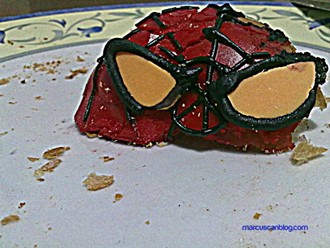


In the real world, Spidey is a Krispy Kreme donut. He did not survive Marcus.

This past weekend, Marcus finally got to watch his first Spidey movie on the big screen though he has been watching over and over and over and over again the Tobey Maguire-starred Spider-Man DVD we have at home.

The Amazing Spider-Man is rated PG13 and not surprisingly it shows sev- eral scenes when we had to cover our son’s eyes to keep him from watching Peter Parker and Gwen Stacy make out. We realized though that he has had enough of seeing hands and jacket in front of his face when he protested and exclaimed, “Not Again!”

There was also another moment when almost every moviegoer was holding their breath as Spider-Man starts swinging from one crane boom to another, on his way to save the city from having more freaky lizards, when our son’s recent fascination with video games got obvious after Spidey disappeared from the frame and an immediate “Game Over!” from Marcus filled the dark cinema. Ti abi.

***

Mood: 2/10 Honks! (Under a nipa waiting shed, waiting for Spidey, I mean Marcus who is currently in the classroom.)